
RMO 2026 · Mathiit worked solutions
RMO 2026 Question Paper and Solutions
Six questions. Two approaches to each.
Read the complete questions and all twelve worked solutions from Mathiit’s student edition, with geometry diagrams and a free downloadable PDF.
How to use this page: Try each question first, then follow one proof completely. Compare it with the second method. The questions follow the supplied Mathiit student copy; the PDF preserves the original layout. Select the second-solution heading to collapse or reopen that method.
Problem 1 of 6
Question 1 · Geometry
Let ABC be a triangle with AB = AC. Let D be the midpoint of BC and P be a point on the segment AB satisfying ∠CPA < 90°. Suppose Q (≠ P) is a point on the circumcircle of triangle BPC such that ∠AQC = 90°. Prove that ∠DQP = 90°.
Solution 1 · Two circles and an angle chase
Draw AD, AQ, CQ, DQ and PQ. The two right angles at D and Q put four points on a second circle.
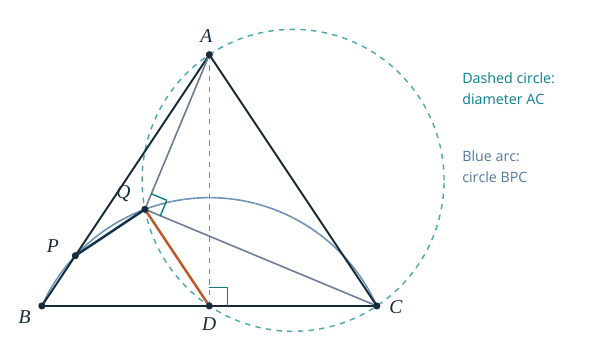
Write ∠ABC = ∠BCA = β. In an isosceles triangle, the median from A is also an altitude and an angle bisector. Hence
Since ∠ADC = ∠AQC = 90°, the points A, D, Q and C lie on the circle with diameter AC. Angles subtending chord DC give
The condition ∠CPA < 90° gives the configuration shown, with B, P, Q, C in that order on their circle. Opposite angles in cyclic quadrilateral BPQC sum to 180°:
The ray QD lies inside ∠PQC. Subtracting the smaller angle gives
∠DQP = (180° − β) − (90° − β) = 90°.
Solution 2 · Coordinates and perpendicular vectors
Place the base on the horizontal axis and scale the figure so that
Write P = (1 + t, h(1 − t)), where 0 < t < 1. The endpoints do not give the nondegenerate configuration in the question. A circle through C and B has equation x² + y² − 2x + ky = 0. Substituting P gives
Put m = h + k. Then hm = 1 + (1 + h²)t. Let Q = (r, s). Since AQ ⟂ CQ, the dot product of the two vectors is zero:
The original circle also gives r² + s² = 2r − ks. Comparing, r = (h + k)s = ms. Since Q ≠ C, we have s ≠ 0. Substitute r = ms into the previous equality:
s = (m + h)/(1 + m²), r = m(m + h)/(1 + m²).
Now calculate the dot product of QD and QP:
= r² + s² − (2 + t)r − h(1 − t)s + 1 + t
= (1 + t)(1 − r) + hts
= [(1 + t)(1 + m²) − (1 + t)m(m + h) + ht(m + h)]/(1 + m²)
= [1 + t − hm + h²t]/(1 + m²) = 0.
The last equality uses hm = 1 + (1 + h²)t. Therefore QD ⟂ QP and ∠DQP = 90°.
Problem 2 of 6
Question 2 · Combinatorics
Consider the following diagram with 102 vertices.
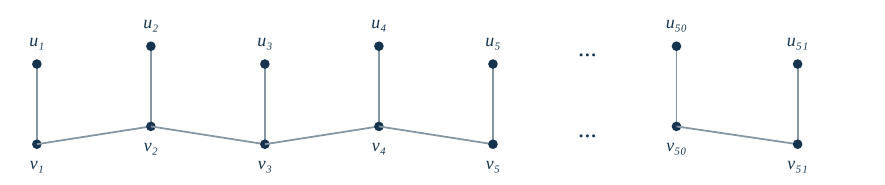
Show that one can assign the numbers 1, 2, …, 102 to the 102 vertices u₁, u₂, …, u₅₁, v₁, v₂, …, v₅₁ such that no two vertices have the same number, and the absolute differences of the numbers on adjacent vertices are a rearrangement of 1, 2, …, 101. Two points are adjacent if a line segment joins them in the diagram.
Solution 1 · An alternating assignment
In column i, use the pair i and 103 − i. If i is odd, assign i to vᵢ and 103 − i to uᵢ. If i is even, reverse the two labels.
| i | 1 | 2 | 3 | 4 | 5 | … | 50 | 51 |
|---|---|---|---|---|---|---|---|---|
| uᵢ | 102 | 2 | 100 | 4 | 98 | … | 50 | 52 |
| vᵢ | 1 | 101 | 3 | 99 | 5 | … | 53 | 51 |
The pairs use 1 to 51 and 52 to 102, so each label is used exactly once. The vertical differences are
which are 101, 99, 97, …, 3, 1: all the odd numbers. Along the lower row,
which are 100, 98, 96, …, 4, 2: all the even numbers.
Together, the 101 edges give each difference from 1 to 101 exactly once.
Solution 2 · Build an assignment from a path
First arrange the numbers 1 to 51 in a row whose neighbouring differences are exactly 1 to 50. Begin with the middle numbers, alternating the smallest and largest remaining entries:
This block has differences 24, 23, …, 1. Follow it by
The joining difference is |26 − 1| = 25, and the second block has differences 50, 49, …, 26. Thus the complete row contains every number 1 to 51 once and every neighbouring difference 1 to 50 once. Call the row t₁, …, t₅₁ and assign
The lower row uses all odd labels 1 to 101; the upper row uses all even labels 2 to 102. For example, the first four tᵢ are 14, 38, 15, 37, giving vᵢ = 27, 75, 29, 73 and uᵢ = 76, 28, 74, 30. The lower-row differences satisfy
so they are precisely 2, 4, …, 100. A vertical difference is
For tᵢ = 1, …, 26 these values are 101, 97, …, 1. For tᵢ = 27, …, 51 they are 3, 7, …, 99. The two lists contain all odd numbers from 1 to 101 without repetition. Thus this second assignment also works.
Problem 3 of 6
Question 3 · Inequalities
Prove that for any two real numbers x and y,
Solution 1 · Completing squares
Put u = x² and v = y², so u, v ≥ 0. The identity
gives u³ − u + 3 ≥ u² + 2, with equality only at u = 1. Similarly, v³ − v + 3 ≥ v² + 2, with equality only at v = 1. The lower bounds are positive, so multiplication preserves the inequalities:
Complete one more square:
Equality in the first comparison requires u = v = 1, whereas equality in the last comparison requires uv = 2. These cannot hold simultaneously, so the required inequality is strict.
(x⁶ − x² + 3)(y⁶ − y² + 3) > 2(x² + y²)² for every real x, y.
Solution 2 · AM–GM and Cauchy–Schwarz
Again let u = x² and v = y². For t ≥ 0, apply AM–GM to t³, t³, 1 and then to t³, 1, 1:
Adding and dividing by 3 gives t³ + 1 ≥ t² + t, hence t³ − t + 3 ≥ t² + 2. Equality holds only at t = 1. Apply this to u and v:
Cauchy–Schwarz applied to (u, √2) and (√2, v) gives
Equality in the AM–GM bounds requires u = v = 1. Equality in Cauchy–Schwarz requires the vectors to be proportional, which requires uv = 2. These conditions are incompatible. The inequality is therefore strict.
Problem 4 of 6
Question 4 · Geometry
Let ABC be an acute triangle and let M and N be the midpoints of AB and AC, respectively. Let T be the point of intersection of ray NM with the circumcircle of ABC. Suppose that the circumcircle of ATM is tangent to AC at A. Let S be the foot of the perpendicular from C on AB. Determine the value of AS/SB.
Solution 1 · Chord products and a parallelogram
Extend MN through N to meet the circumcircle of ABC at X. The order on the line is X, N, M, T.
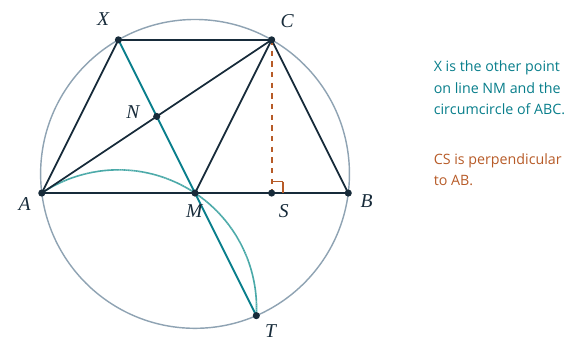
For circle ATM, NA is a tangent and NMT is a secant. Thus NA² = NM · NT. For circle ABC, the intersecting chords AC and XT give NA · NC = NX · NT. Since NA = NC,
N is therefore the midpoint of both AC and XM. The diagonals of quadrilateral AMCX bisect each other, so AMCX is a parallelogram. Consequently CX ∥ AB and AX = MC. Since CX ∥ AB, ∠XCA = ∠BAC. These equal angles on the same circle subtend equal chords, so AX = BC. Hence MC = BC.
Triangle MCB is isosceles. Its altitude CS bisects MB, giving
AS/SB = (AM + MS)/SB = (3AB/4)/(AB/4) = 3.
Solution 2 · Equations of two circles
Take M as the origin and AB horizontal. Scale so that A = (−1, 0), B = (1, 0), M = (0, 0), C = (u, v), where v > 0. Then N = ((u − 1)/2, v/2). Write
Here λ ≠ 0. The centre O of circle ATM lies on the perpendicular bisector of AM, so O = (−1/2, w). Since OA is perpendicular to AC,
The circle passes through M, so its equation is x² + y² + x + ((u + 1)/v)y = 0. Substituting T and dividing by λ gives
The circumcircle of ABC has equation
Substituting T, then using (1), yields λ(1 − u² − v² − 2u) = 1. Multiply by R and use λR = −2u:
(2u − 1)((u + 1)² + v²) = 0.
The second factor is positive since v > 0. Thus u = 1/2 and S = (1/2, 0). Hence AS/SB = (1 + 1/2)/(1 − 1/2) = 3.
Problem 5 of 6
Question 5 · Number theory
Let a be an integer greater than 1. Determine all positive integers b which have the property that aᵇ + 1 divides a number of the form aⁿ + b for some positive integer n.
Solution 1 · Working with remainders
Put m = aᵇ + 1. We use the bound b ≤ 2ᵇ⁻¹ ≤ aᵇ⁻¹. For b ≥ 2, the first inequality follows from the first two terms of (1 + 1)ᵇ⁻¹; for b = 1 it is equality. Therefore, for 0 ≤ r < b,
Write n = qb + r with q ≥ 0 and 0 ≤ r < b. Because aᵇ ≡ −1 (mod m),
If q is even, m would divide b + aʳ, contradicting (1). If q is odd, m divides b − aʳ. But |b − aʳ| < m, so this difference must be zero. Hence b = aʳ.
Conversely, let b = aᵏ for any nonnegative integer k. Choose n = b + k. Then
Exactly b = 1, a, a², a³, … work; equivalently, b = aᵏ for k = 0, 1, 2, … .
Solution 2 · Choose the smallest exponent
Suppose b works. Set m = aᵇ + 1 and choose the smallest positive n such that m divides aⁿ + b. If n > 2b, subtract the multiple
from aⁿ + b. This shows that m also divides aⁿ⁻²ᵇ + b, contradicting minimality of n. If n = 2b, then
Since 0 < b + 1 < m, this is impossible. Thus n < 2b. On the other hand, if n < b, the bound b ≤ aᵇ⁻¹ gives
again impossible. Therefore b ≤ n < 2b. Write n = b + k with 0 ≤ k < b. Then
The difference b − aᵏ is divisible by m and has absolute value less than m, so b = aᵏ. Conversely, for every b = aᵏ the positive exponent n = b + k gives aⁿ + b = aᵏ(aᵇ + 1). This proves the same complete list.
Problem 6 of 6
Question 6 · Inequalities and rearrangements
Let n be a fixed positive integer and S be a fixed positive real number. Find the minimum constant c, in terms of S and n, such that:
Given any positive real numbers a₁, a₂, …, aₙ with a₁ + a₂ + ··· + aₙ = S, there is a rearrangement b₁, b₂, …, bₙ of a₁, a₂, …, aₙ such that
Solution 1 · Pairing complementary powers
When n = 1, the expression is 2S = S + Sⁿ. Now suppose n ≥ 2. Reverse the list: bᵢ = aₙ₊₁₋ᵢ. If E denotes the expression in the question, then, after reindexing the second sum,
For every t > 0,
For t ≥ 1 both bracketed factors are nonnegative; for 0 < t ≤ 1 both are nonpositive. Thus tⁱ + tⁿ⁺¹⁻ⁱ ≤ t + tⁿ. Apply this to each aᵢ and add:
In (a₁ + ··· + aₙ)ⁿ, each aᵢⁿ occurs and the remaining terms are nonnegative. Hence ∑aᵢⁿ ≤ Sⁿ, so E ≤ S + Sⁿ.
Why the constant cannot be smaller
Choose ε > 0 small enough that t = S − (n − 1)ε > 0. Use one entry t and n − 1 entries ε. If 0 < S ≤ 1, put t first. The original sum contributes at least t, and in every rearrangement t has an exponent j between 1 and n. Since 0 < t < 1, tʲ ≥ tⁿ, so E ≥ t + tⁿ.
If S > 1, choose ε so that t > 1 and put t last. The original sum contributes at least tⁿ; in any rearrangement tʲ ≥ t, so again E ≥ tⁿ + t. As ε tends to zero, t tends to S and these lower bounds tend to S + Sⁿ. Any smaller constant fails for sufficiently small positive ε. The small entries remain positive throughout.
The minimum constant is c = S + Sⁿ.
Solution 2 · AM–GM bounds for powers
For n = 1, c = 2S. For n ≥ 2, again choose the reverse rearrangement. Since 0 < aᵢ ≤ S,
E ≤ ∑i=1n aᵢ(Sⁱ⁻¹ + Sⁿ⁻ⁱ).
Apply AM–GM to n − i copies of 1 and i − 1 copies of Sⁿ⁻¹. Their geometric mean is Sⁱ⁻¹. Thus
Interchanging the numbers of copies gives
Adding yields Sⁱ⁻¹ + Sⁿ⁻ⁱ ≤ 1 + Sⁿ⁻¹. The endpoint cases i = 1 and i = n give equality directly. Consequently,
Sharpness
Choose ε > 0 small enough that t = S − (n − 1)ε > 0. Use one entry t and n − 1 entries ε. If 0 < S ≤ 1, put t first. The original sum contributes at least t, and in every rearrangement t has an exponent j between 1 and n. Since 0 < t < 1, tʲ ≥ tⁿ, so E ≥ t + tⁿ.
If S > 1, choose ε so that t > 1 and put t last. The original sum contributes at least tⁿ; in any rearrangement tʲ ≥ t, so again E ≥ tⁿ + t. As ε tends to zero, t tends to S and these lower bounds tend to S + Sⁿ. Any smaller constant fails for sufficiently small positive ε. The small entries remain positive throughout.
Thus c = S + Sⁿ is both sufficient and the smallest possible universal constant.
Download and continue learning
Download Mathiit’s 14-page student PDF
Keep a record of the key idea in each proof: a second circle, an explicit construction, equality conditions, power of a point, remainders, and a sharp limiting example.
RMO guide and past papers · More free worked practice · Exam news
Sources and editorial note
- Questions, diagrams and two solution methods: Mathiit RMO 2026 Student Copy — Two Solutions, supplied for this release.
- Exam date, duration and six-question format: HBCSE Mathematical Olympiad 2026–2027 announcement, checked on 16 November 2026.
- Official papers and marking schemes, when listed: HBCSE past-paper archive.
The web version adapts notation for mobile reading. Results, cutoffs and selection decisions must be checked with the official organisers. To report a transcription or mathematical issue, use Contact us; see our corrections policy.